
The Most Powerful Part of the Real Estate Contract Nobody Uses
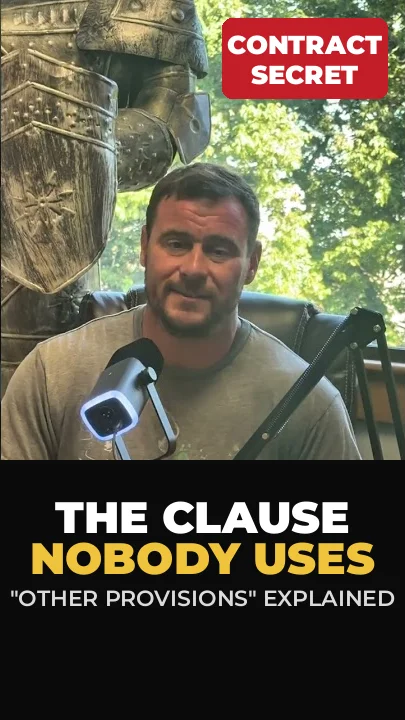
Most real estate contracts are designed to handle the situations we see every day: financing, inspections, appraisals, closing dates, possession, and other common issues.
But real estate deals don't always present common problems.
Sometimes a client needs a solution that isn't sitting there waiting for you in a checkbox.
That's where the "Other Provisions" section can become one of the most valuable parts of the contract.
A Real-Life Example
A few years ago, I listed a house for my plumber, Ronnie.
Before we even had his house ready to put on the market, his dream home popped up for sale. We went to see it, wrote an offer, and got it accepted.
There was just one problem: Ronnie needed to sell his existing house in order to buy the new one, so our offer included a home-sale contingency.
A couple of days later, the sellers received another offer.
Under the terms of our contract, they gave us notice requiring Ronnie to remove his contingency or potentially lose the house.
Normally, that would have been a major problem.
His existing house wasn't even ready to hit the market. We probably needed another week just to get it prepared.
The conventional answer would have been to tell Ronnie that he couldn't remove the contingency and we'd simply have to hope another dream house came along.
I didn't particularly like that answer.
Watch the full story: I walk through exactly how this deal came together in this week's video. Watch on YouTube →
So We Created Another Option
I called an investor I'd worked with before and explained the situation.
I was planning to list Ronnie's house around $200,000.
I offered the investor an opportunity to put it under contract for $150,000 cash.
Obviously, buying a house worth somewhere around $200,000 for $150,000 sounds pretty attractive.
But there was an important condition.
Using the Other Provisions section of the contract, we structured the agreement so Ronnie retained the right to publicly market his property for sale.
If Ronnie received another offer he wanted to accept, he had the contractual right to terminate the investor's purchase agreement.
That created an interesting situation where everyone had an incentive to participate.
For the investor, it was an asymmetric opportunity. If nobody came along with a better deal, he potentially bought a property at a substantial discount. If another buyer did, the contract was terminated and he moved on.
For Ronnie, the cash contract gave him the certainty he needed to move forward with the purchase of his new home while still preserving the opportunity to expose his existing house to the open market and pursue a much higher price.
Then We Put the House on the Market
I originally thought we could sell Ronnie's house for around $200,000.
I was wrong.
We sold it for $215,000.
Ronnie closed on his dream home, eventually built a pretty sweet pool in the backyard, and he still lives there today.
Had we simply accepted the obvious answer when the contingency became a problem, he might never have bought that house.
The Bigger Lesson
Real estate agents absolutely need to understand the contracts they're using.
But understanding a contract isn't just knowing what every paragraph says.
It's understanding how the different pieces can be used to accomplish your client's goals.
Every transaction has different people, different motivations, different risks, and different problems. Sometimes the solution isn't already printed on the form.
Sometimes you have to create it.
That's why I think the Other Provisions section can be one of the most powerful parts of a real estate contract.
A good agent can identify a problem.
A great agent should be able to help build a solution.
Just the Tip Tuesday is my weekly series breaking down real-world real estate situations, negotiation strategies, contracts, and lessons I've learned over more than a decade in the business.
Facing a tricky contract situation?
Every episode and post starts from a real client question. If yours isn't covered yet, let's talk it through directly.
Book a Strategy Call