

 By Ryan Brown
·
Contracts & Negotiation
·
September 22, 2026
·
6 min read
The real estate market has changed.
With 47% of listings experiencing a price reduction, sellers no longer have the overwhelming leverage they had during the hottest years of the market. And one consequence I'm seeing more often is deals running into trouble because of low appraisals.
Low appraisals aren't new. What has changed is what happens after you get one.
Local check: as of September 22, 2026, 2,029 of the 4,290 active residential listings in the Greater Louisville MLS — 47.3% — are currently priced below where they originally started. That's the market sellers are appraising into right now.
When Buyers Were Willing to Cover the Gap
A few years ago, sellers had tremendous leverage.
If a house was under contract for $400,000 and appraised for $385,000, buyers would sometimes simply bring another $15,000 to closing to make up the difference. In particularly competitive situations, buyers were even agreeing in advance to cover appraisal gaps as part of their offers.
That isn't nearly as easy to count on in today's market.
When an appraisal comes in below the contract price now, buyers generally have more negotiating leverage. That means sellers and their agents need to think about the appraisal before it ever happens.
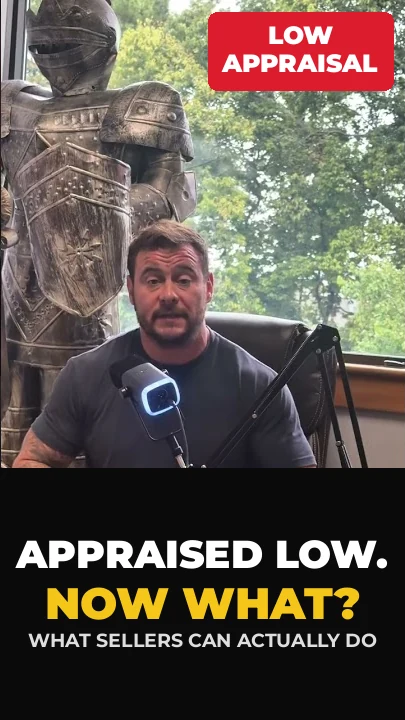
Watch this week's episode: I break down the whole low-appraisal playbook in about two minutes. Watch on YouTube →
Be Proactive With the Appraiser
If I'm representing a seller and I'm concerned about the appraisal, I don't want to wait for the report to come back.
I want the appraiser to have useful information about the property before completing the appraisal.
That can include:
- Comparable sales that support the contract price
- A list of improvements and upgrades
- Information about renovations and their dates
- Features that distinguish the property from nearby comparable sales
- Relevant information about the neighborhood or property that may not be obvious during a walkthrough
The goal isn't to pressure an appraiser into hitting a particular number. The goal is to make sure the appraiser has good information before forming an opinion of value.
Once a low appraisal is completed, fixing the problem becomes considerably more difficult.
What If the Appraisal Still Comes in Low?
The first option is generally a Reconsideration of Value, commonly called an ROV.
We can review the appraisal for factual errors, questionable comparable sales, missed comps, or other information that might support a different value. That information can then be submitted through the appropriate process to request that the value be reconsidered.
Sometimes it works.
Sometimes it doesn't.
Depending on the loan and circumstances, there may also be an opportunity for the lender to obtain another appraisal. But this is important for sellers to understand:
The seller doesn't control that decision.
It's the buyer's loan, and the lender ultimately determines whether another appraisal is appropriate.
Usually, You're Back to Negotiating
If the appraisal doesn't change, you're essentially entering another negotiation.
Imagine the contract price is $400,000 and the appraisal comes back at $385,000.
The seller could reduce the price to $385,000.
The buyer could potentially bring additional cash.
Or maybe they meet somewhere in the middle — the buyer brings $5,000 more and the seller reduces the price by $10,000.
There isn't one answer that works for every transaction.
It depends on the buyer's financial position, the seller's motivation, the contract terms, the financing, how much interest the property received, and what alternatives each side has if the transaction falls apart.
“Fine. We'll Just Put It Back on the Market.”
That's always an option.
But sellers need to be careful before assuming that terminating the transaction automatically gives them a clean slate.
This is particularly important when dealing with FHA and VA financing.
Government-backed appraisals operate under rules that can allow an existing appraisal or valuation to remain relevant for a period of time. That means if an FHA or VA transaction falls apart after a low appraisal, putting the house back on the market and finding another government-backed buyer doesn't necessarily guarantee that you'll simply receive a brand-new appraisal and a different value.
That's something I want my seller to understand before deciding whether to renegotiate the current transaction or go back to the market.
The Best Appraisal Problem Is the One You Prevent
You can't control an appraiser's opinion of value.
But you can be prepared.
If I'm representing a seller, I want to know which comparable sales support our price. I want to know where the weaknesses are. I want the appraiser to know about significant improvements and relevant property features.
And if the appraisal still comes in short, I want to understand every available option before advising my seller on the next move.
Because in today's market, a low appraisal doesn't necessarily mean the deal is dead.
It usually means the negotiation just started again.
And the more proactive you are before the appraisal, the more options you're likely to have afterward.
Just the Tip Tuesday is my weekly series breaking down real-world real estate situations, negotiation strategies, contracts, and lessons I've learned over more than a decade in the business. Price-reduction figures above are from the Greater Louisville MLS, active single-family and condo listings, pulled September 22, 2026.
Worried about the appraisal on your sale?
The prep work happens before the appraiser ever pulls in the driveway. Let's look at your comps and find the weak spots first.
Send a Message